
Paper trading on prediction markets is the act of taking positions on live markets using simulated money, keeping price mechanics intact while removing financial risk.
It evaluates two distinct factors:
- Is your analytical reasoning accurate?
- Will your execution hold when capital is on the line?
The first yields a reliable baseline; the second requires real market exposure to evaluate.
How does paper trading work in practice?
A paper trade tracks real exchange prices without sending orders to the order book. On Chironus, a simulated order fills at the active ask on entry and the active bid on exit, which bakes real bid-ask spreads directly into your paper performance. Every account starts with $1,000 in simulated capital.
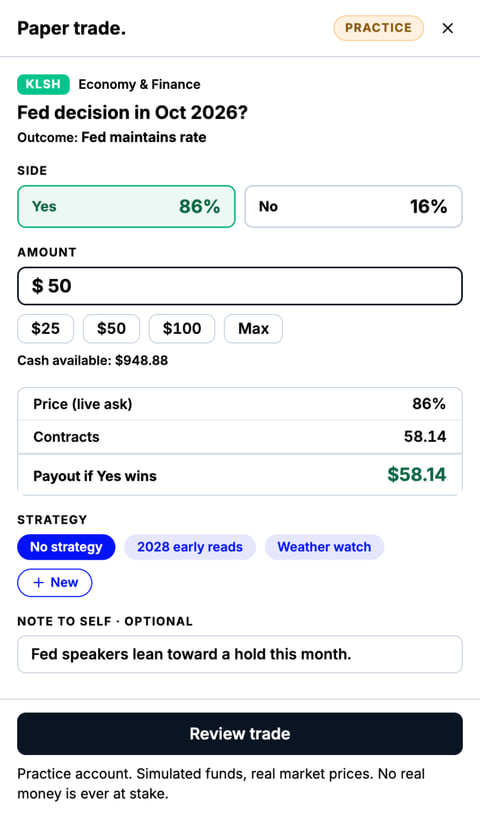
Pick a side, set an amount, and place a practice trade at the live price on Chironus.
Some exchanges provide practice environments as well: Kalshi operates a standalone demo platform where users "practice trading using mock funds".1Kalshi Help Center, "Creating a demo account on Kalshi," help.kalshi.com, accessed October 2026
Because no capital is committed to the exchange, execution carries zero financial risk; a losing position incurs no monetary loss beyond the documented record.
What does paper trading teach that reading prices does not?
- Reading the rules before committing: Holding a position through settlement reveals how a market actually resolves.
- The cost of the spread: Buying at the ask and selling at the bid demonstrates what a round trip costs before the event outcome occurs.
- Timing: Markets can stop trading before their listed date, which paper trading forces you to track without risking money on an unexpected early close.
- Writing down why: Documenting your logic at entry lets you audit your thought process when the market settles; on Chironus, a note and up to two strategy tags can be added to any position and changed after resolution. A 2022 study of geopolitical forecasting tournaments found that top forecasters write out nuanced arguments that weigh alternative views and draw on past examples.2Karvetski, Meinel, Maxwell, Lu, Mellers and Tetlock, "What do forecasting rationales reveal about thinking patterns of top geopolitical forecasters?," International Journal of Forecasting 38(2), 2022
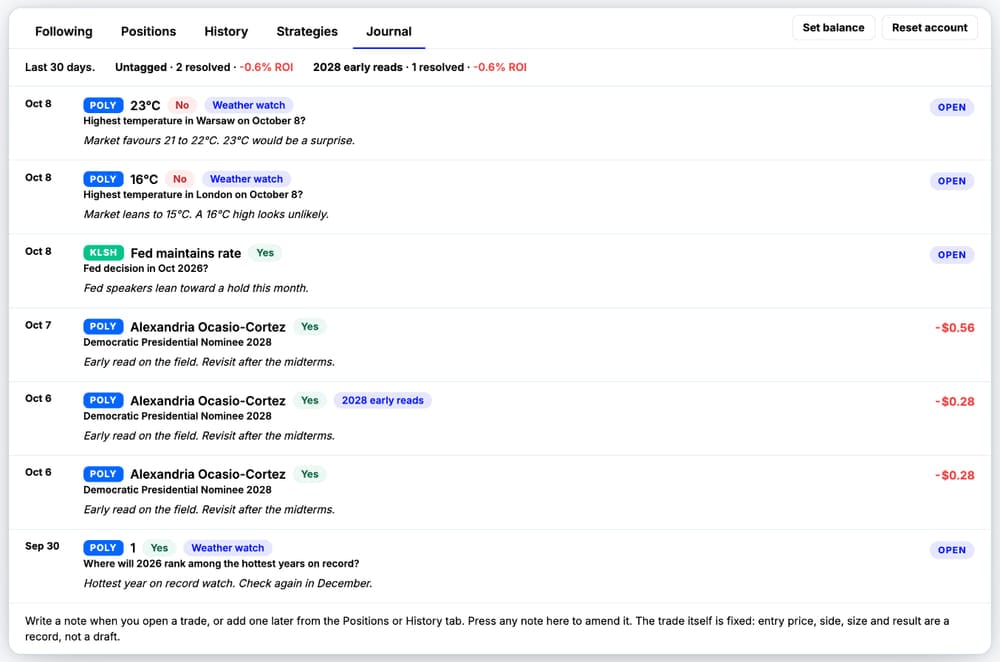
Keep a note on every position in your journal, and group trades into strategies to see what works.
Track events you care about. Set up free alerts in 30 seconds.
Why can a high win rate be misleading?
A win rate measures prediction frequency, not financial return. Because prediction market prices represent implied probabilities, taking heavy positions on high-probability outcomes produces a high percentage of winning trades, but yields very small payouts relative to the capital exposed.
For example, buying No contracts at 89 cents across ten markets yields an 11-cent profit per win. A single loss wipes out roughly eight of those wins, requiring an 89% accuracy rate just to break even.
Without tracking dollar payout alongside accuracy, a winning record can easily disguise a small return.
Does paper trading predict how you will do with real money?
Yes, as a test of reasoning, with caveats. It shows whether your analysis holds up against live market prices, but it cannot measure how you behave when real capital is on the line.
- Crowd accuracy in practice-money markets: A 2004 study comparing NFL predictions found that a practice-money market (NewsFutures) forecasted game outcomes just as accurately as a real-money market (TradeSports), and both outperformed most individual forecasters.3Servan-Schreiber, Wolfers, Pennock and Galebach, "Prediction Markets: Does Money Matter?," Electronic Markets 14(3), 2004 Note that this study evaluated overall market accuracy, not individual trader behavior.
- Behavioral shifts with real stakes: Real financial stakes change human risk tolerance. In lab experiments, scaling up real payments by 20 times made participants significantly more cautious, while scaling up hypothetical payments by the same amount produced no significant change in behavior.4Holt and Laury, "Risk Aversion and Incentive Effects: New Data without Order Effects," American Economic Review 95(3), 2005
- Absence of market impact: A paper order does not move order book prices or consume liquidity, because it places no orders on the exchange.
Paper trading is a sound test of your reasoning, as long as you evaluate the record for total return as well as accuracy, and do not treat it as proof of how you will trade with real money.