Practice trading prediction markets.
Practice trading on live prices, with simulated money. Keep a record to test strategies and make more informed trading decisions.
A lot of prediction market participants do not run the preparation, research and learning loops that are standard in mature markets. The point of paper trading is to give you the tools to test strategies and get familiar in a safe environment.
Step one
Find markets you want to follow.
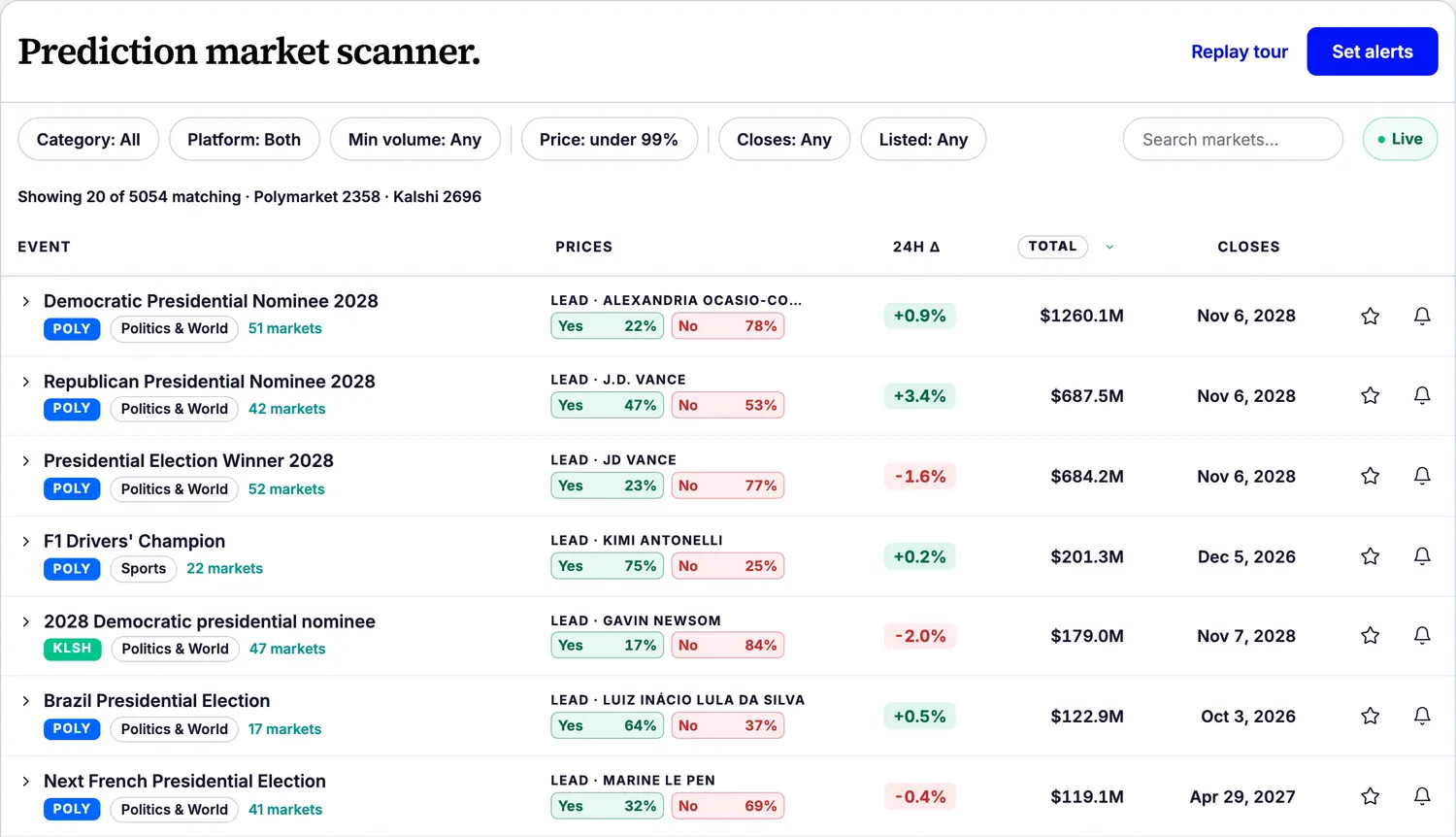
The scanner lists every market on Polymarket and Kalshi carrying at least $5,000 in volume ($1,000 for weather markets), plus anything you follow and anything a Chironus article is tracking. Filter by category, price, volume or close date, search by name, and open an event to see the markets inside it.
Following an event puts every market inside it on your Dashboard. One event is one slot, whatever it holds, so a field with forty candidates costs the same as a yes or no question.
Set the categories you care about once in your discovery preferences, and matching markets arrive on your Dashboard ready to follow, and in the weekly digest. Category pages narrow the same scanner to a single subject.
Step two
Set and manage alerts.
- Daily morning brief: a 24 hour snapshot of movements on your followed events and open positions. Optional on every plan, and off until you switch it on.
- Weekly digest: a recap across the markets and categories you follow, the trades you have made, and suggestions that match your discovery preferences. On by default, on every plan.
- Alerts as prices move: Pro accounts get an email within a minute or two of a market inside a followed event crossing the move you set.
Sensitivity starts at a 10 percent move and can be adjusted globally or per event. Quiet hours and a daily cap manage frequency, and any event can be muted without unfollowing it.
See plansStep three
Execute a mock trade.
Paper trading uses simulated funds, not real money. A mock trade places nothing on Polymarket or Kalshi, but it fills at the real ask on the way in and the real bid on the way out, so the spread is a real cost and nothing fills at a price nobody is offering.
Every account starts with $1,000 in simulated funds, and the balance can be set to anything up to $1,000,000.
Tag a trade with up to two strategies to test and track performance, and add a note to any position, open or closed, to keep track of your theses. Both the tags and the note can be changed later, including after the market resolves.
Executing a trade will automatically follow the full event, so the position appears on your Dashboard without a second step.
Practice balance $773.59Reset any time
Step four
Track open positions.
Your Dashboard has its own tabs for followed events, open positions, closed history, strategies and the journal. Dashboard rows expand and carry all the same information as scanner rows.
An open position shows your entry, the exit price it would actually get, and real time profit and loss. Positions can be added to at any time, and closing one is never capped or queued.
Step five
Study historical records.
Every closed position is kept in history, where you can track your win rate and your return, and compare the results of different strategies.
Each strategy carries its own record, and the journal reads back as a list of theses you can mark right or wrong. That is the part worth returning to: a bucket that loses money becomes visible instead of being remembered fondly.