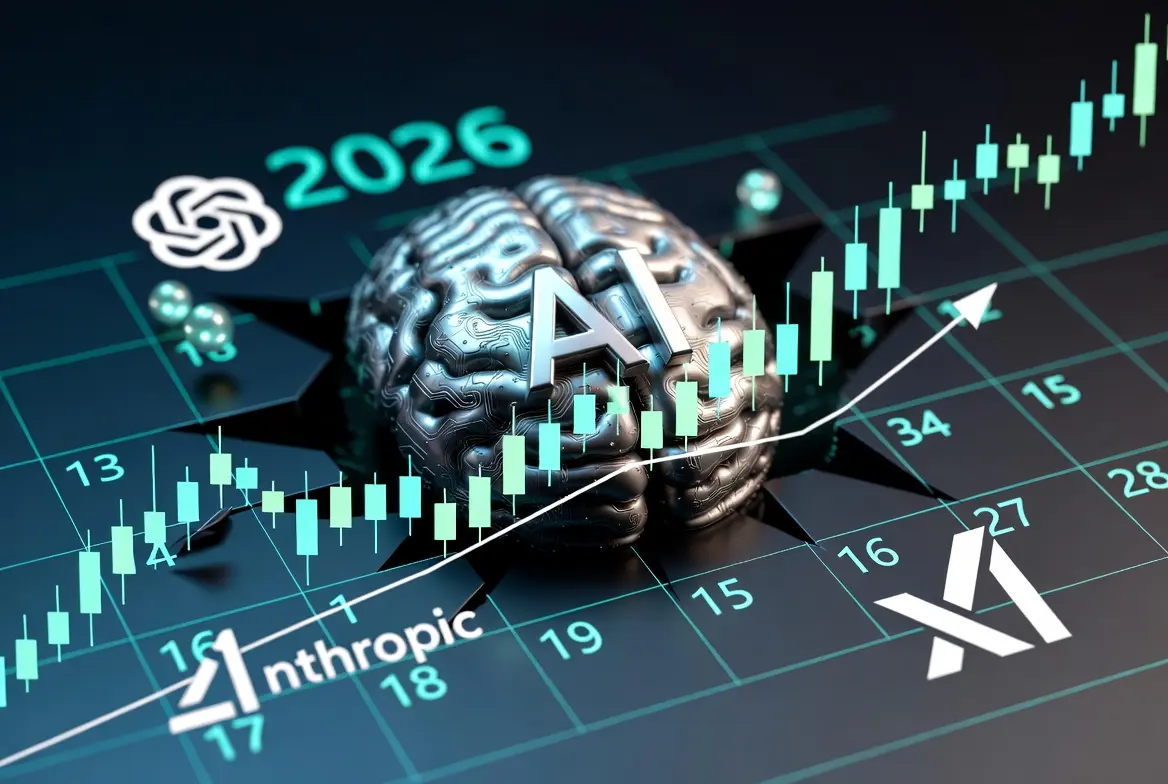
AI IPOs and valuations: OpenAI, Anthropic, and the model race

The world's leading artificial intelligence research laboratories operate as private companies, meaning their shares do not trade on public stock exchanges and their corporate valuations must be estimated during private funding rounds rather than quoted on a ticker. An initial public offering (IPO) represents the first sale of a company's stock to the public on a registered exchange. Until a lab completes an IPO, its implied market value is derived from primary venture capital rounds and private secondary market transactions between existing shareholders.
Evaluating frontier AI companies requires analyzing commercial revenue growth, cloud distribution partnerships, and unique corporate governance structures. As enterprise demand for large language models accelerates, market participants track corporate revenue trajectories, strategic investments from tech conglomerates, and the statutory SEC registration steps required for private AI firms to transition into publicly traded corporations.
What do frontier AI labs do, and how do they make money?
Frontier AI laboratories develop foundational artificial intelligence models, generating commercial revenue by selling model access through developer platforms and structured subscription plans. Companies like Anthropic (creators of Claude) and OpenAI (creators of ChatGPT) build reliable, high-capability AI systems, deploying their research through direct application programming interfaces (APIs) and consumer applications.
Developer platforms price model usage per million text tokens processed, offering discounts for batch processing workloads while distributing models through major cloud partners including Amazon Web Services, Google Cloud, and Microsoft Foundry. Alongside developer API access, AI labs offer tiered subscription plans for individual consumers and enterprise teams. Commercial agreements, such as Amazon's strategic distribution of Claude via Amazon Bedrock or Microsoft's integration of OpenAI models across Azure, represent primary channels driving enterprise monetization.
Many leading AI companies operate under non-traditional corporate structures. Delaware public benefit corporations allow directors to balance stockholder financial returns against explicit public benefit goals written into their charters. Rapid commercial expansion across the sector has driven annualized run-rate revenues from billions to tens of billions of dollars, providing the baseline for private market valuation ladders.
Are AI companies like Anthropic and OpenAI publicly traded?
As of September, 2026, neither Anthropic nor OpenAI is publicly traded. Shares in these leading AI laboratories are not listed on any registered stock exchange, neither company carries a public ticker symbol, and searches of the U.S. Securities and Exchange Commission (SEC) filing database for active registration statements yield no public listings. Private equity changes hands periodically among accredited investors and institutional funds, which explains why investment vehicles holding private AI equity appear in SEC filings while the operating companies themselves do not.
Transitioning to a publicly traded corporation in the United States follows a strict regulatory sequence. The Securities Act of 1933 requires an issuer to file a public registration statement (such as a Form S-1) with the SEC. Shares cannot be sold to the public until SEC staff declare the registration statement effective, after which the stock can formally list and commence regular-way trading on a national exchange.
Financial markets evaluate potential IPO timelines by watching for preliminary regulatory indicators. These include confidential draft registration filings permitted under federal securities laws, corporate governance restructuring milestones, and official executive announcements confirming an intent to list.
Who owns the major AI laboratories?
Frontier AI laboratories are owned by their founders, early employees, strategic technology partners, and major institutional venture capital firms. Anthropic, founded at the beginning of 2021 by siblings Dario Amodei and Daniela Amodei, includes specialized governance structures like the Long-Term Benefit Trust, an independent board holding Class T stock with authority over corporate board seats. OpenAI, led by chief executive Sam Altman, includes equity backing from strategic partners alongside private venture holders.
External equity ownership across the sector is distributed among major strategic tech companies and growth funds. Google and Amazon hold significant minority positions in Anthropic tied to cloud distribution agreements, while Microsoft holds substantial economic interests in OpenAI. Subsequent funding rounds across the AI industry have raised tens of billions of dollars per tranche, drawing capital from global institutional funds.
Corporate ownership continues to evolve through structural recapitalizations and secondary liquidity programs. Market analysts track private market valuation benchmarks, strategic acquisition offers, and governance shifts to evaluate where equity ownership and board control will transition next.
Funding rounds and major AI milestones.
- 2021: Anthropic was founded at the beginning of the year by former OpenAI research executives, led by Dario Amodei and Daniela Amodei.
- May 2021: A $124 million Series A funding round for Anthropic closed, led by Skype co-founder Jaan Tallinn.
- Apr 2022: Anthropic completed a $580 million Series B financing round.
- Mar 2023: Claude was officially released, offering access through a web interface and developer API.
- May 2023: A $450 million Series C round led by Spark Capital closed for Anthropic, with participation from Google.
- Sep 2023: Amazon announced a strategic investment of up to $4 billion in Anthropic for a minority position, expanding model distribution via Amazon Bedrock.
- Sep 2023: Anthropic established the Long-Term Benefit Trust to oversee corporate governance via Class T stock.
- Dec 2023: Google announced Gemini, its multimodal AI model family released across three operational sizes.
- Mar 2025: Anthropic completed a $3.5 billion Series E funding round at a $61.5 billion post-money valuation.
- Sep 2025: A $13 billion Series F funding round led by ICONIQ closed at a $183 billion post-money valuation for Anthropic.
- Oct 2025: Microsoft publicly supported proposal efforts by the OpenAI board to recapitalize as a public benefit corporation.
- Feb 2026: Anthropic closed a $30 billion Series G funding round led by GIC and Coatue at a $380 billion post-money valuation.
- Apr 2026: Anthropic signed an infrastructure agreement with Google and Broadcom to secure multi-gigawatt tensor processing unit capacity.
- May 2026: A $65 billion Series H funding round closed for Anthropic at a $965 billion post-money valuation.
- Jul 2026: Claude Opus 5 was officially released to enterprise developers and consumers.
AI IPO and valuation prediction markets.
events · marketsFrequently asked questions.
More in Economy & Finance.
SpaceX Prediction Markets 2026: Starship, Launches, Moon
The SpaceX IPO has priced and settled. What still trades: Starship reusability and launch cadence, docking milestones, NASA Moon timelines, and the Tesla merger question, live on Polymarket and Kalshi.

Bitcoin Price Prediction 2026: Live Prices & Forecasts
BTC price thresholds, altcoin returns, crypto regulation, and institutional stress contracts on Polymarket and Kalshi.

Gold, Oil & Silver: 2026 Year-End Price Predictions
The mid-year gold, oil, and silver contracts settled in June. What still trades: year-end gold touch and level ladders, the WTI maximum and minimum ladders, crude record-high contracts, and the cross-asset return races on Polymarket and Kalshi.
Economy & Finance explainers.

How Small Businesses Hedge Risk With Prediction Markets
A bar, an ice cream shop, and a conference organizer all hedged real business risk with prediction market contracts. How the hedges worked, what the arithmetic looks like, and where the limits sit.